



How Side Bets Work in Blackjack Switch
Blackjack Switch Side Bets add a second layer of action to a game already built around two hands and one unusual decision: Swapping the second card between them. The key is knowing which cards decide each side bet, when the result is locked in, and how the displayed paytable changes the value of the wager.
Blackjack Switch Side Bets Start Outside the Main Hands
Blackjack Switch begins with two separate blackjack hands. Both require equal initial wagers, and once the cards are dealt, the second card of one hand can be exchanged with the second card of the other.
That switching mechanic gets most of the attention, but side bets sit outside it.
Suppose the round starts with:
- PHP 200 on Hand A
- PHP 200 on Hand B
- PHP 50 on Super Match
The initial amount committed is PHP 450. The PHP 50 does not become part of either blackjack hand. It has its own winning condition and its own payout.
That separation is worth keeping clear because the outcomes can easily move in opposite directions. You might lose Super Match and still win both main hands. You can also hit a strong side-bet result while the blackjack hands themselves finish poorly.
A side bet is not a bonus attached to a winning blackjack hand. It is a separate wager settled under separate rules.
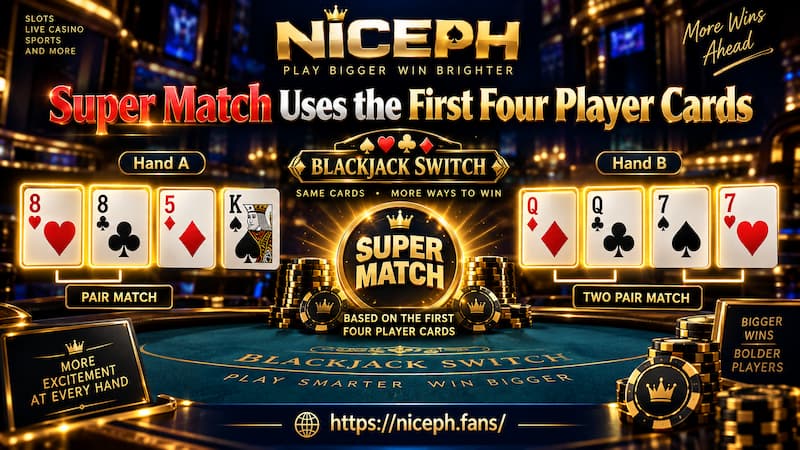
Super Match Uses the First Four Player Cards
Super Match, sometimes simply called Match, is one of the side bets most closely associated with Blackjack Switch.
Super Match Uses the First Four Player Cards
The wager looks at the four cards originally dealt to your two hands. Dealer cards are irrelevant, and cards drawn later through hitting or doubling do not enter the calculation.
Imagine you receive:
- Hand A: 8♠, K♦
- Hand B: 8♥, 4♣
Those four opening cards already contain a pair of eights. If the table pays for one pair, the Super Match result is established before the blackjack hands continue.
Switching Cards Does Not Change the Match
This is where the structure becomes interesting.
You could switch K♦ and 4♣, leaving:
- Hand A: 8♠, 4♣
- Hand B: 8♥, K♦
The blackjack hands changed, but the same four cards are still present. Your Super Match result remains one pair.
That means there is no reason to make a bad blackjack switch in an attempt to improve Super Match. Once the opening four cards are on the table, the side bet has effectively reached its result.
Common Super Match Winning Hands
A commonly used Super Match structure rewards four categories.
One Pair
Two of the four cards share the same rank.
Example: 6♠, K♥, 6♦, 3♣.
A frequently quoted payout is 1:1.
Three of a Kind
Three cards have the same rank.
Example: Q♠, Q♥, Q♦, 5♣.
A common reference payout is 5:1.
Two Pair
The four cards contain two separate pairs.
Example: 9♠, 9♥, J♦, J♣.
Some six-deck schedules pay 8:1 for this result.
Four of a Kind
All four cards share the same rank.
Example: 4♠, 4♥, 4♦, 4♣.
A widely documented schedule pays 40:1.
Four of a kind naturally attracts attention because of the headline return, but it is also the rarest result. Looking only at the largest payout gives an incomplete picture of the wager.
The Super Match Paytable Is Part of the Rule Set
Blackjack Switch Side Bets should never be judged by name alone. Two games can both display “Super Match” and still use slightly different payout schedules.
One regulated six-deck schedule, for example, can use:
- One Pair: 1:1
- Three of a Kind: 5:1
- Two Pair: 8:1
- Four of a Kind: 40:1
Another configuration can reduce the two-pair payout while increasing four of a kind. That changes the expected return even though the winning combinations remain familiar.
Highest Qualifying Result
When the opening four cards meet more than one description, the wager is normally settled using the highest qualifying category rather than adding several payouts together.
Four 7s contain multiple theoretical pairs, but the result is four of a kind. You do not collect the four-of-a-kind payout plus pair payouts underneath it.
That detail seems small until real money is involved. Reading the paytable before placing the wager avoids assumptions carried over from another Blackjack Switch table.
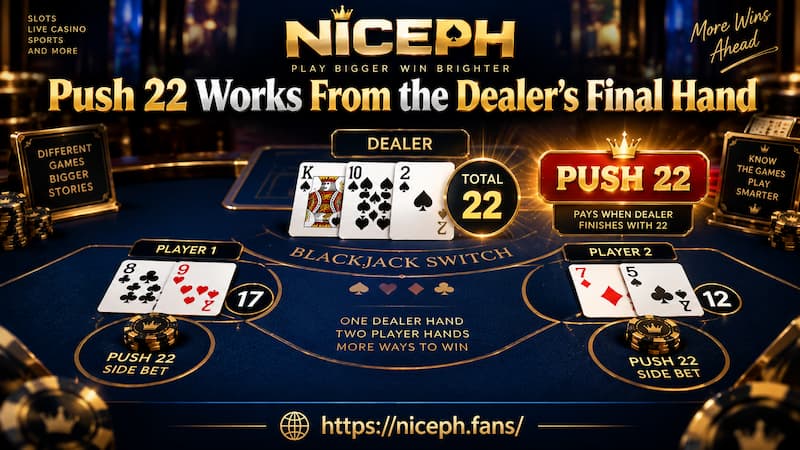
Push 22 Works From the Dealer’s Final Hand
Push 22 is fundamentally different from Super Match.
Push 22 Works From the Dealer’s Final Hand
Super Match is decided by your opening four cards. Push 22, where offered as a separate wager, depends on the dealer finishing with exactly 22.
To understand the side bet, first remember one of Blackjack Switch’s defining house rules: A dealer total of 22 commonly pushes against surviving player hands instead of busting in the normal blackjack sense.
So if your hand finishes on 19 and the dealer reaches 22, the main hand may push rather than win.
Push 22 as a Separate Wager
Some Blackjack Switch variations add a dedicated wager on that exact dealer result.
A documented version pays 11:1 when the dealer finishes on 22.
The payout sounds substantial, but probability matters more than appearance. In a six-deck game where the dealer hits soft 17, a dealer 22 occurs only a relatively small percentage of the time. Published mathematical analysis of an 11:1 version places its house edge much higher than the commonly cited Super Match schedule.
This creates a useful contrast:
- Super Match depends on four opening player cards.
- Push 22 depends on the dealer’s completed total.
- The switch decision directly changes neither winning condition.
Switching Strategy and Side-Bet Results Should Stay Separate
The name Blackjack Switch can tempt players into connecting every wager to the card swap. That is not how the side bets operate.
Your switch should be made to improve the two blackjack hands.
For example, imagine the deal produces:
- Hand A: 10, 6
- Hand B: 5, K
Switching the second cards would create 10-K and 5-6, turning one awkward 16 into a strong 20. That decision affects the main game.
If Super Match has already recognized a pair or another four-card combination, the swap does not rewrite the four cards originally dealt. If Push 22 is active, the dealer still has to finish on 22 regardless of which second cards you exchanged.
Keeping these layers separate makes decisions cleaner and prevents side-bet excitement from interfering with the hand that carries the larger stake.
Reading Blackjack Switch Side Bets Before Wagering
The fastest way to understand a side bet is not to memorize every version ever published. Read the specific rules attached to the table you are opening.
Before placing the first optional wager, check four things:
- Identify the trigger. Is the wager based on your first four cards, the dealer’s final total, or another event?
- Read every payout. A familiar side-bet name does not guarantee an identical paytable.
- Check the deck and dealer rules. Small rule differences can change the mathematics.
- Add the side bet to total round exposure. A “small” PHP 50 wager becomes meaningful when repeated beside two mandatory main bets.
Consider a PHP 300 round on each blackjack hand with a PHP 100 side bet. You already have PHP 700 committed before any double or split. If both hands later double, exposure rises quickly.
That is a more useful way to view side bets than looking only at the potential payout.
Checking Blackjack Switch Side Bets at PH33
When playing through PH33, treat the in-game rule panel as the final authority for the Blackjack Switch version you open. Providers can use different deck counts, limits and side-bet schedules, so a payout remembered from another live casino table should not be assumed to apply automatically.
Three Details to Confirm
Before adding an optional wager, look for:
- The exact side bet offered, such as Super Match or Push 22
- The minimum and maximum PHP wager allowed
- The payout attached to every winning combination
If Super Match pays differently from the schedule you already know, that is not necessarily an error. It may simply be another approved game configuration.
Blackjack Switch Side Bets in Practice
Blackjack Switch Side Bets become easier to handle once each wager is tied to its actual trigger.
Super Match belongs to the opening deal. It evaluates the four initial player cards and can pay for combinations such as one pair, three of a kind, two pair or four of a kind. Push 22 is dealer-driven and wins only when the dealer reaches the required total on versions that offer the wager.
Neither should dictate the card switch between the two main hands. The practical habit is simple: Make the switch for blackjack, evaluate the side bet by its own rules and read the exact paytable every time the provider or table changes. That keeps an already distinctive blackjack variant clear, controlled and much easier to understand.